mlterm
Tested Software version 3.9.4 on Linux. The homepage URL of this terminal is https://mlterm.sourceforge.net/. Full results available at ucs-detect repository path data/mlterm.yaml.
Score Breakdown
Detailed breakdown of how scores are calculated for mlterm:
# |
Score Type |
Raw Score |
Final Scaled Score |
|---|---|---|---|
1 |
55.93% |
45.1% |
|
2 |
100.00% |
100.0% |
|
3 |
0.00% |
0.0% |
|
4 |
85.19% |
85.2% |
|
5 |
50.00% |
50.0% |
|
6 |
0.00% |
(excluded) |
|
7 |
0.00% |
0.0% |
|
8 |
100.00% |
100.0% |
|
9 |
98.85% |
98.9% |
|
10 |
33.33% |
33.3% |
|
11 |
100% |
100.0% |
|
12 |
65.3% |
65.3% |
Score Comparison Plot:
The following plot shows how this terminal’s scores compare to all other terminals tested.
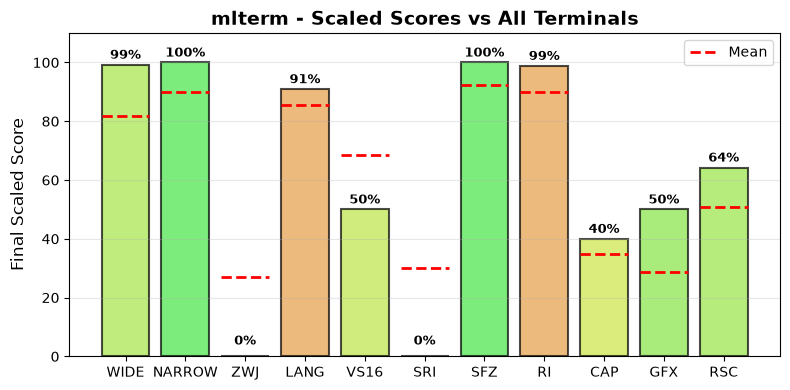
Scaled scores comparison across all metrics (normalized 0-100%)
Final Scaled Score Calculation:
Raw Final Score: 62.04% (weighted average: WIDE + NARROW + ZWJ + LANG + VS16 + 0.33 * SRI + 0.33 * SFZ + RI + CAP + 0.5 * GFX) the categorized ‘average’ absolute support level of this terminal.
Note
RSC (Resources) is a composite CPU, memory, and runtime score, displayed for comparison but excluded from the final score FEAT (Features) is the fraction of notable features supported. GFX (Graphics) scores 100% for modern protocols (iTerm2, Kitty), 50% for legacy only (Sixel, ReGIS), 0% for none.
Final Scaled Score: 37.3% (normalized across all terminals tested). Final Scaled scores are normalized (0-100%) relative to all terminals tested
WIDE Score Details:
Wide character support calculation:
Total successful contested codepoints: 283
Total contested codepoints tested: 506
Formula: 283 / 506
Result: 55.93%
NARROW Score Details:
Narrow character support calculation:
Total successful contested codepoints: 5595
Total contested codepoints tested: 5595
Formula: 5595 / 5595
Result: 100.00%
ZWJ Score Details:
Emoji ZWJ (Zero-Width Joiner) support calculation:
Total successful sequences: 0
Total sequences tested: 1445
Formula: 0 / 1445
Result: 0.00%
VS16 Score Details:
Variation Selector-16 support calculation:
Errors: 213 of 426 codepoints tested
Success rate: 50.0%
Formula: 50.0 / 100
Result: 50.00%
Variation Selector-15 support:
Note
Interpretation of VS-15 is contested. Its width behavior is not consistently implemented across terminals; this measurement is informational and excluded from final scoring.
Variation Selector-15 support calculation:
Errors: 158 of 158 codepoints tested
Success rate: 0.0%
Formula: 0.0 / 100
Result: 0.00%
SRI Score Details:
Standalone Regional Indicator support calculation:
Total successful codepoints: 0
Total codepoints tested: 26
Formula: 0 / 26
Result: 0.00%
SFZ Score Details:
Standalone Fitzpatrick skin tone modifier support calculation:
Total successful codepoints: 5
Total codepoints tested: 5
Formula: 5 / 5
Result: 100.00%
RI Score Details:
Regional Indicator flag sequence support calculation:
Total successful sequences: 259
Total sequences tested: 262
Formula: 259 / 262
Result: 98.85%
Features Score Details:
Notable terminal features (6.0 / 18):
Kitty Keyboard: no
XTGETTCAP (Partial): partial
Tofu Detection: no
OSC 52 Clipboard: no
Truecolor Detection: partial
Raw score: 33.33%
Graphics Score Details:
Graphics protocol support (100%):
Sixel: yes
ReGIS: yes
iTerm2: yes
Kitty: no
Scoring: 100% for modern (iTerm2/Kitty), 50% for legacy only (Sixel/ReGIS), 0% for none
Resource Score Details:
Duration: 31.3s
Mean CPU: 52.1%
Mean RSS: 28.1 MB
Resources Score: 65/100
Note: log-scale composite cost = log(CPU+1) + log(RSS+1) + log(time+1)
Scaled result: 65.3%
LANG Score Details (Geometric Mean):
Geometric mean calculation:
Formula: (p₁ × p₂ × … × pₙ)^(1/n) where n = 85 contested languages
About geometric mean
Result: 85.19%
Wide character support
Wide character support of mlterm is 97.3% (1206 errors of 44568 codepoints tested).
Sequence of a WIDE character, from midpoint of alignment failure records:
# |
Codepoint |
Python |
Category |
wcwidth |
Name |
|---|---|---|---|---|---|
1 |
‘\U0001900b’ |
Cn |
2 |
na |
Total codepoints: 1
Shell test using printf(1),
'|'should align in output:$ printf "\xf0\x99\x80\x8b|\\n12|\\n" | 12|
Screenshot:
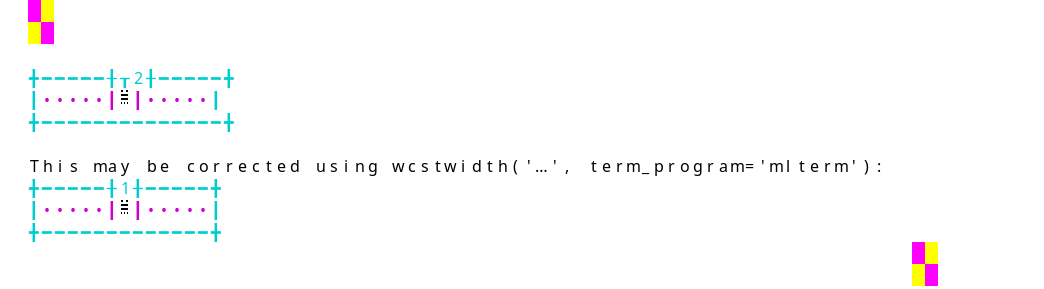
python wcwidth.wcswidth() measures width 2, while mlterm measures width 1.
Narrow character support
Narrow character support of mlterm is 100.0% (0 errors of 36254 codepoints tested).
Emoji ZWJ support
Compatibility of mlterm with the Unicode Emoji ZWJ sequence table is 0.0% (1445 errors of 1445 sequences tested).
Sequence of an Emoji ZWJ Sequence, from midpoint of alignment failure records:
# |
Codepoint |
Python |
Category |
wcwidth |
Name |
|---|---|---|---|---|---|
1 |
‘\U0001f3c3’ |
So |
2 |
RUNNER |
|
2 |
‘\U0001f3ff’ |
Sk |
2 |
EMOJI MODIFIER FITZPATRICK TYPE-6 |
|
3 |
‘\u200d’ |
Cf |
0 |
ZERO WIDTH JOINER |
|
4 |
‘\u2640’ |
So |
1 |
FEMALE SIGN |
|
5 |
‘\ufe0f’ |
Mn |
0 |
VARIATION SELECTOR-16 |
Total codepoints: 5
Shell test using printf(1),
'|'should align in output:$ printf "\xf0\x9f\x8f\x83\xf0\x9f\x8f\xbf\xe2\x80\x8d\xe2\x99\x80\xef\xb8\x8f|\\n12|\\n" 🏃🏿♀️| 12|
Screenshot:
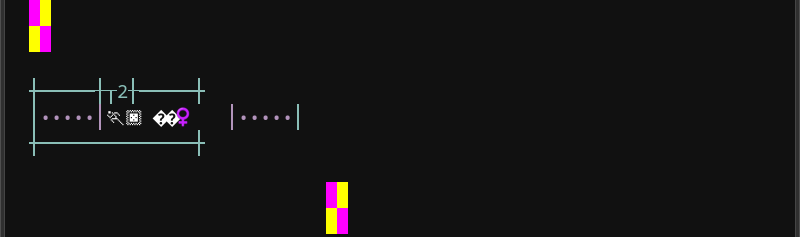
python wcwidth.wcswidth() measures width 2, while mlterm measures width 6.
Variation Selector-16 support
Emoji VS-16 results for mlterm is 213 errors out of 426 total codepoints tested, 50.0% success. Sequence of a NARROW Emoji made WIDE by Variation Selector-16, from midpoint of alignment failure records:
# |
Codepoint |
Python |
Category |
wcwidth |
Name |
|---|---|---|---|---|---|
1 |
‘\u2733’ |
So |
1 |
EIGHT SPOKED ASTERISK |
|
2 |
‘\ufe0f’ |
Mn |
0 |
VARIATION SELECTOR-16 |
Total codepoints: 2
Shell test using printf(1),
'|'should align in output:$ printf "\xe2\x9c\xb3\xef\xb8\x8f|\\n12|\\n" ✳️| 12|
Screenshot:
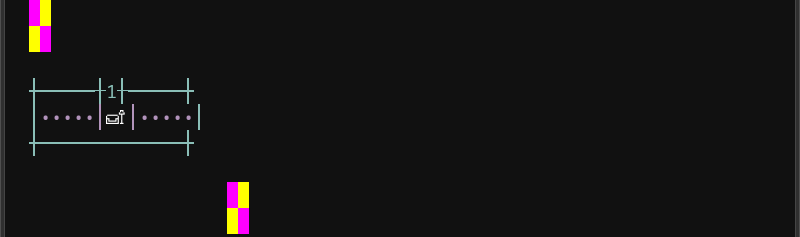
python wcwidth.wcswidth() measures width 2, while mlterm measures width 1.
Variation Selector-15 support
Emoji VS-15 results for mlterm is 158 errors out of 158 total codepoints tested, 0.0% success. Sequence of a WIDE Emoji made NARROW by Variation Selector-15, from midpoint of alignment failure records:
# |
Codepoint |
Python |
Category |
wcwidth |
Name |
|---|---|---|---|---|---|
1 |
‘\U0001f3ae’ |
So |
2 |
VIDEO GAME |
|
2 |
‘\ufe0e’ |
Mn |
0 |
VARIATION SELECTOR-15 |
Total codepoints: 2
Shell test using printf(1),
'|'should align in output:$ printf "\xf0\x9f\x8e\xae\xef\xb8\x8e|\\n1|\\n" 🎮︎| 1|
Screenshot:

python wcwidth.wcswidth() measures width 1, while mlterm measures width 2.
Standalone Regional Indicator support
Standalone Regional Indicator support of mlterm is 0.0% (26 errors of 26 codepoints tested).
Sequence of a standalone Regional Indicator, from midpoint of alignment failure records:
# |
Codepoint |
Python |
Category |
wcwidth |
Name |
|---|---|---|---|---|---|
1 |
‘\U0001f1f3’ |
So |
2 |
REGIONAL INDICATOR SYMBOL LETTER N |
Total codepoints: 1
Shell test using printf(1),
'|'should align in output:$ printf "\xf0\x9f\x87\xb3|\\n12|\\n" 🇳| 12|
Screenshot:

python wcwidth.wcswidth() measures width 2, while mlterm measures width 1.
Standalone Fitzpatrick modifier support
Standalone Fitzpatrick skin tone modifier support of mlterm is 100.0% (0 errors of 5 codepoints tested).
Regional Indicator flag sequence support
Regional Indicator flag sequence support of mlterm is 98.9% (3 errors of 262 sequences tested).
Sequence of a Regional Indicator flag sequence, from midpoint of alignment failure records:
# |
Codepoint |
Python |
Category |
wcwidth |
Name |
|---|---|---|---|---|---|
1 |
‘\U0001f3f4’ |
So |
2 |
WAVING BLACK FLAG |
|
2 |
‘\U000e0067’ |
Cf |
0 |
TAG LATIN SMALL LETTER G |
|
3 |
‘\U000e0062’ |
Cf |
0 |
TAG LATIN SMALL LETTER B |
|
4 |
‘\U000e0073’ |
Cf |
0 |
TAG LATIN SMALL LETTER S |
|
5 |
‘\U000e0063’ |
Cf |
0 |
TAG LATIN SMALL LETTER C |
|
6 |
‘\U000e0074’ |
Cf |
0 |
TAG LATIN SMALL LETTER T |
|
7 |
‘\U000e007f’ |
Cf |
0 |
CANCEL TAG |
Total codepoints: 7
Shell test using printf(1),
'|'should align in output:$ printf "\xf0\x9f\x8f\xb4\xf3\xa0\x81\xa7\xf3\xa0\x81\xa2\xf3\xa0\x81\xb3\xf3\xa0\x81\xa3\xf3\xa0\x81\xb4\xf3\xa0\x81\xbf|\\n12|\\n" 🏴| 12|
Screenshot:
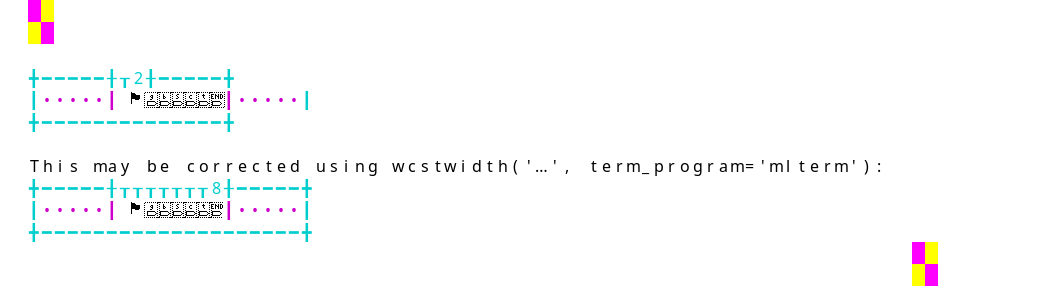
python wcwidth.wcswidth() measures width 2, while mlterm measures width 8.
Graphics Protocol Support
mlterm supports the following graphics protocols: Sixel, ReGIS, iTerm2 inline images.
Detection Methods:
Sixel and ReGIS: Detected via the Device Attributes (DA1) query
CSI c(\x1b[c). Sixel indicator (4): present, ReGIS indicator (3): present.Kitty graphics: Not detected by sending a Kitty graphics query and checking for an
OKresponse.iTerm2 inline images: Detected by drawing a 1x1 transparent image,
OSC 1337 ; File=inline=1, and checking that the cursor advanced a single column.iTerm2 capabilities: Not detected via the
OSC 1337 ; Capabilitiesquery, which does not describe image support, and does not contribute to this score.
Device Attributes
Raw response:
'\x1b[?63;1;2;3;4;6;7;15;18;22;29c'Service class: 63 (VT320)
Detected Extensions:
Code
Description
1
132-column mode
2
Printer port
3
ReGIS graphics
4
Sixel graphics
6
Selective erase
7
Soft character sets (DRCS)
15
Technical character set
18
User windows
22
ANSI color
29
Text locator (mouse)
Language Support
The following 90 languages were tested with 100% success:
(Jinan), (Yeonbyeon), Aja, Amarakaeri, Arabic, Standard, Assyrian Neo-Aramaic, Baatonum, Bamun, Belanda Viri, Bora, Catalan (2), Chickasaw, Chinantec, Chiltepec, Chinese, Gan, Chinese, Hakka, Chinese, Jinyu, Chinese, Mandarin (Beijing), Chinese, Mandarin (Guiyang), Chinese, Mandarin (Harbin), Chinese, Mandarin (Nanjing), Chinese, Mandarin (Simplified), Chinese, Mandarin (Tianjin), Chinese, Mandarin (Traditional), Chinese, Min Nan, Chinese, Wu, Chinese, Xiang, Chinese, Yue, Colorado, Dagaare, Southern, Dangme, Dendi, Dinka, Northeastern, Ditammari, Dzongkha, Evenki, Fon, French (Welche), Fur, Ga, Gen, Gilyak, Gumuz, Japanese, Japanese (Osaka), Japanese (Tokyo), Kabyle, Korean, Lamnso’, Lao, Lingala (tones), Maldivian, Maori (2), Mazahua Central, Mirandese, Mixtec, Metlatónoc, Mongolian, Halh (Mongolian), Mòoré, Nanai, Navajo, Nuosu, Orok, Otomi, Mezquital, Pashto, Northern, Picard, Pular (Adlam), Saint Lucian Creole French, Secoya, Seraiki, Shipibo-Conibo, Siona, South Azerbaijani, Tagalog (Tagalog), Tai Dam, Tamazight, Central Atlas, Tem, Thai, Thai (2), Tibetan, Central, Ticuna, Uduk, Urdu, Urdu (2), Veps, Vietnamese, Vietnamese (Han nom), Waama, Yaneshaʼ, Yiddish, Eastern, Yoruba, Éwé.
The following 28 languages are not fully supported:
lang |
n_errors |
n_total |
pct_success |
|---|---|---|---|
197 |
293 |
32.8% |
|
106 |
175 |
39.4% |
|
106 |
175 |
39.4% |
|
158 |
287 |
44.9% |
|
112 |
258 |
56.6% |
|
333 |
844 |
60.5% |
|
144 |
385 |
62.6% |
|
26 |
70 |
62.9% |
|
120 |
343 |
65.0% |
|
108 |
313 |
65.5% |
|
103 |
302 |
65.9% |
|
102 |
314 |
67.5% |
|
126 |
391 |
67.8% |
|
121 |
390 |
69.0% |
|
103 |
352 |
70.7% |
|
76 |
268 |
71.6% |
|
101 |
357 |
71.7% |
|
138 |
493 |
72.0% |
|
116 |
443 |
73.8% |
|
86 |
384 |
77.6% |
|
68 |
332 |
79.5% |
|
86 |
530 |
83.8% |
|
67 |
419 |
84.0% |
|
34 |
267 |
87.3% |
|
18 |
181 |
90.1% |
|
4 |
49 |
91.8% |
|
4 |
54 |
92.6% |
|
1 |
62 |
98.4% |
Sanskrit (Grantha)
Sequence of language Sanskrit (Grantha) from midpoint of alignment failure records:
# |
Codepoint |
Python |
Category |
wcwidth |
Name |
|---|---|---|---|---|---|
1 |
‘\U00011305’ |
Lo |
1 |
GRANTHA LETTER A |
|
2 |
‘\U00011302’ |
Mc |
0 |
GRANTHA SIGN ANUSVARA |
Total codepoints: 2
Shell test using printf(1),
'|'should align in output:$ printf "\xf0\x91\x8c\x85\xf0\x91\x8c\x82|\\n12|\\n" 𑌅𑌂| 12|
Screenshot:
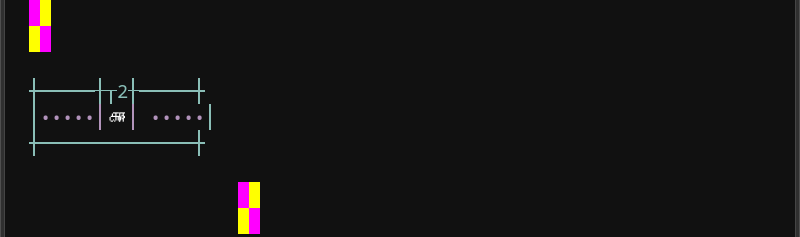
python wcwidth.wcswidth() measures width 2, while mlterm measures width 1.
Tamil
Sequence of language Tamil from midpoint of alignment failure records:
# |
Codepoint |
Python |
Category |
wcwidth |
Name |
|---|---|---|---|---|---|
1 |
‘\u0b95’ |
Lo |
1 |
TAMIL LETTER KA |
|
2 |
‘\u0bbe’ |
Mc |
0 |
TAMIL VOWEL SIGN AA |
Total codepoints: 2
Shell test using printf(1),
'|'should align in output:$ printf "\xe0\xae\x95\xe0\xae\xbe|\\n12|\\n" கா| 12|
Screenshot:
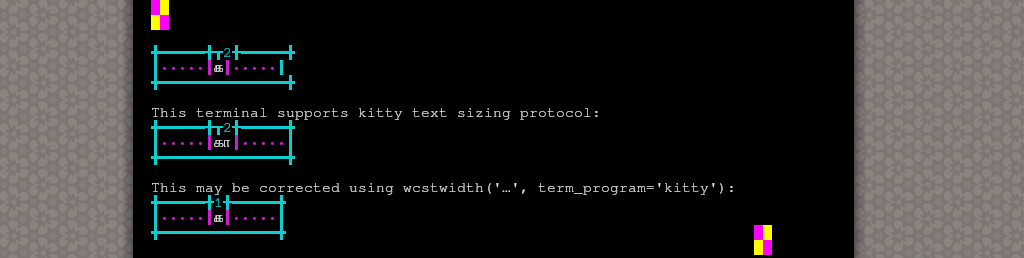
python wcwidth.wcswidth() measures width 2, while mlterm measures width 1.
Tamil (Sri Lanka)
Sequence of language Tamil (Sri Lanka) from midpoint of alignment failure records:
# |
Codepoint |
Python |
Category |
wcwidth |
Name |
|---|---|---|---|---|---|
1 |
‘\u0b95’ |
Lo |
1 |
TAMIL LETTER KA |
|
2 |
‘\u0bbe’ |
Mc |
0 |
TAMIL VOWEL SIGN AA |
Total codepoints: 2
Shell test using printf(1),
'|'should align in output:$ printf "\xe0\xae\x95\xe0\xae\xbe|\\n12|\\n" கா| 12|
Screenshot:
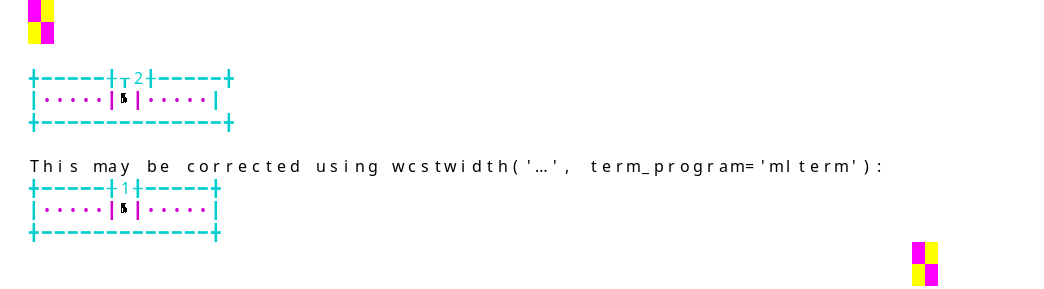
Kannada
Sequence of language Kannada from midpoint of alignment failure records:
# |
Codepoint |
Python |
Category |
wcwidth |
Name |
|---|---|---|---|---|---|
1 |
‘\u0c85’ |
Lo |
1 |
KANNADA LETTER A |
|
2 |
‘\u0c82’ |
Mc |
0 |
KANNADA SIGN ANUSVARA |
Total codepoints: 2
Shell test using printf(1),
'|'should align in output:$ printf "\xe0\xb2\x85\xe0\xb2\x82|\\n12|\\n" ಅಂ| 12|
Screenshot:
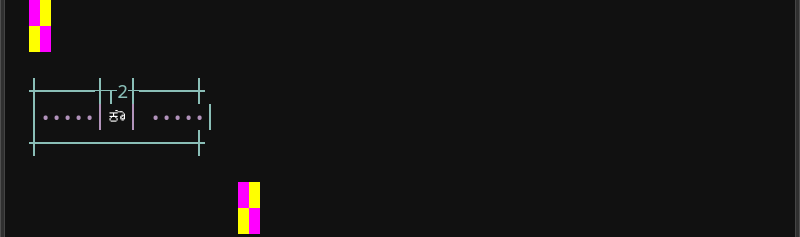
python wcwidth.wcswidth() measures width 2, while mlterm measures width 1.
Sinhala
Sequence of language Sinhala from midpoint of alignment failure records:
# |
Codepoint |
Python |
Category |
wcwidth |
Name |
|---|---|---|---|---|---|
1 |
‘\u0d9a’ |
Lo |
1 |
SINHALA LETTER ALPAPRAANA KAYANNA |
|
2 |
‘\u0dcf’ |
Mc |
0 |
SINHALA VOWEL SIGN AELA-PILLA |
Total codepoints: 2
Shell test using printf(1),
'|'should align in output:$ printf "\xe0\xb6\x9a\xe0\xb7\x8f|\\n12|\\n" කා| 12|
Screenshot:
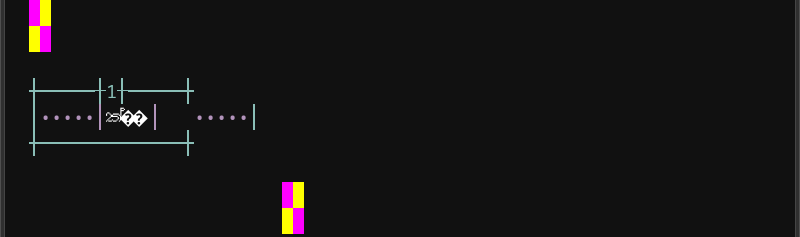
python wcwidth.wcswidth() measures width 2, while mlterm measures width 1.
Malayalam
Sequence of language Malayalam from midpoint of alignment failure records:
# |
Codepoint |
Python |
Category |
wcwidth |
Name |
|---|---|---|---|---|---|
1 |
‘\u0d05’ |
Lo |
1 |
MALAYALAM LETTER A |
|
2 |
‘\u0d02’ |
Mc |
0 |
MALAYALAM SIGN ANUSVARA |
Total codepoints: 2
Shell test using printf(1),
'|'should align in output:$ printf "\xe0\xb4\x85\xe0\xb4\x82|\\n12|\\n" അം| 12|
Screenshot:

python wcwidth.wcswidth() measures width 2, while mlterm measures width 1.
Bengali
Sequence of language Bengali from midpoint of alignment failure records:
# |
Codepoint |
Python |
Category |
wcwidth |
Name |
|---|---|---|---|---|---|
1 |
‘\u0985’ |
Lo |
1 |
BENGALI LETTER A |
|
2 |
‘\u0982’ |
Mc |
0 |
BENGALI SIGN ANUSVARA |
Total codepoints: 2
Shell test using printf(1),
'|'should align in output:$ printf "\xe0\xa6\x85\xe0\xa6\x82|\\n12|\\n" অং| 12|
Screenshot:
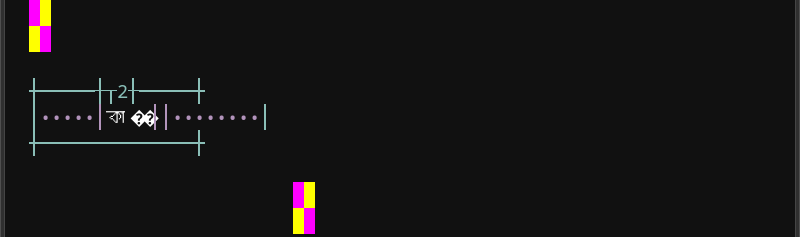
python wcwidth.wcswidth() measures width 2, while mlterm measures width 1.
Tamang, Eastern
Sequence of language Tamang, Eastern from midpoint of alignment failure records:
# |
Codepoint |
Python |
Category |
wcwidth |
Name |
|---|---|---|---|---|---|
1 |
‘\u0915’ |
Lo |
1 |
DEVANAGARI LETTER KA |
|
2 |
‘\u093e’ |
Mc |
0 |
DEVANAGARI VOWEL SIGN AA |
Total codepoints: 2
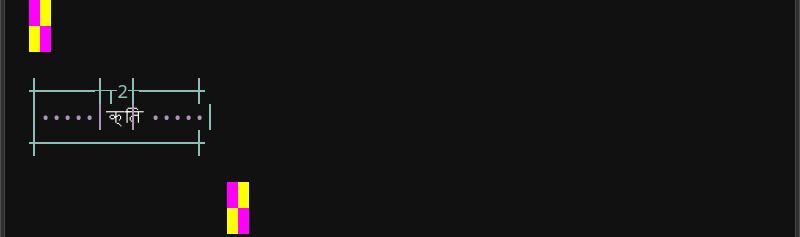
Shell test using printf(1),
'|'should align in output:$ printf "\xe0\xa4\x95\xe0\xa4\xbe|\\n12|\\n" का| 12|
Screenshot:
Gujarati
Sequence of language Gujarati from midpoint of alignment failure records:
# |
Codepoint |
Python |
Category |
wcwidth |
Name |
|---|---|---|---|---|---|
1 |
‘\u0a95’ |
Lo |
1 |
GUJARATI LETTER KA |
|
2 |
‘\u0a83’ |
Mc |
0 |
GUJARATI SIGN VISARGA |
Total codepoints: 2
Shell test using printf(1),
'|'should align in output:$ printf "\xe0\xaa\x95\xe0\xaa\x83|\\n12|\\n" કઃ| 12|
Screenshot:
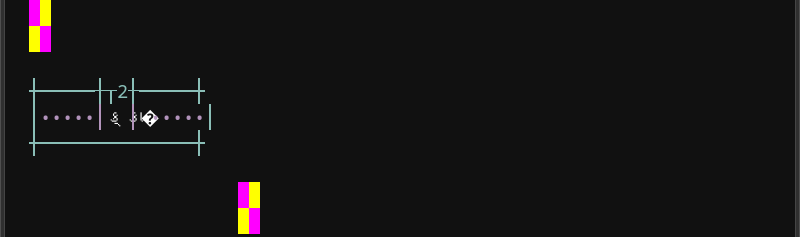
python wcwidth.wcswidth() measures width 2, while mlterm measures width 1.
Bhojpuri
Sequence of language Bhojpuri from midpoint of alignment failure records:
# |
Codepoint |
Python |
Category |
wcwidth |
Name |
|---|---|---|---|---|---|
1 |
‘\u0915’ |
Lo |
1 |
DEVANAGARI LETTER KA |
|
2 |
‘\u093e’ |
Mc |
0 |
DEVANAGARI VOWEL SIGN AA |
Total codepoints: 2
Shell test using printf(1),
'|'should align in output:$ printf "\xe0\xa4\x95\xe0\xa4\xbe|\\n12|\\n" का| 12|
Screenshot:
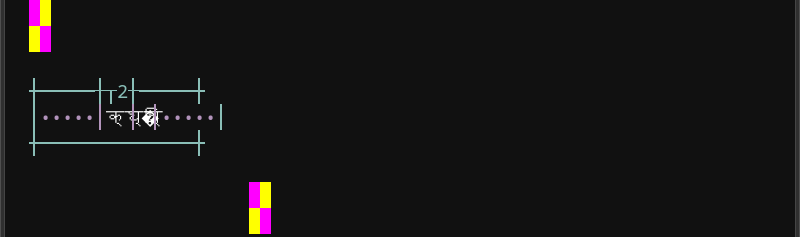
python wcwidth.wcswidth() measures width 2, while mlterm measures width 1.
Panjabi, Eastern
Sequence of language Panjabi, Eastern from midpoint of alignment failure records:
# |
Codepoint |
Python |
Category |
wcwidth |
Name |
|---|---|---|---|---|---|
1 |
‘\u0a15’ |
Lo |
1 |
GURMUKHI LETTER KA |
|
2 |
‘\u0a3e’ |
Mc |
0 |
GURMUKHI VOWEL SIGN AA |
Total codepoints: 2
Shell test using printf(1),
'|'should align in output:$ printf "\xe0\xa8\x95\xe0\xa8\xbe|\\n12|\\n" ਕਾ| 12|
Screenshot:
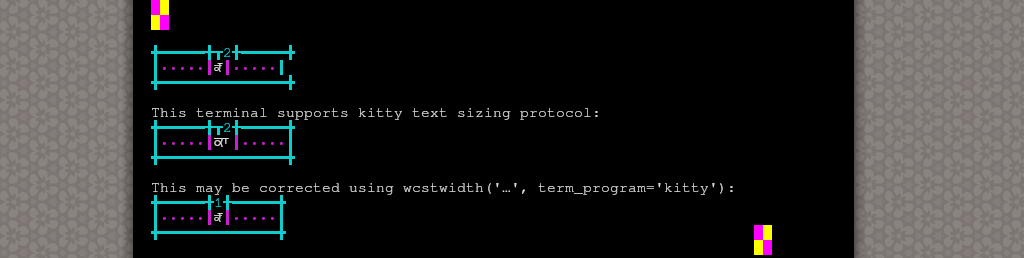
python wcwidth.wcswidth() measures width 2, while mlterm measures width 1.
Magahi
Sequence of language Magahi from midpoint of alignment failure records:
# |
Codepoint |
Python |
Category |
wcwidth |
Name |
|---|---|---|---|---|---|
1 |
‘\u0915’ |
Lo |
1 |
DEVANAGARI LETTER KA |
|
2 |
‘\u093e’ |
Mc |
0 |
DEVANAGARI VOWEL SIGN AA |
Total codepoints: 2
Shell test using printf(1),
'|'should align in output:$ printf "\xe0\xa4\x95\xe0\xa4\xbe|\\n12|\\n" का| 12|
Screenshot:
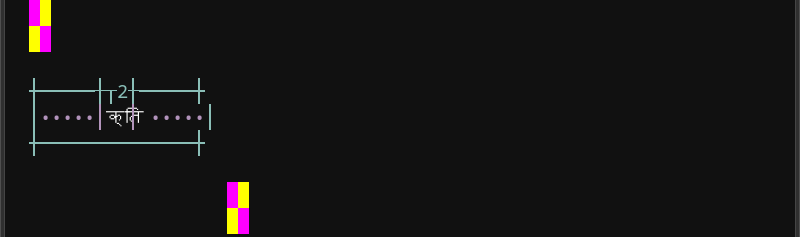
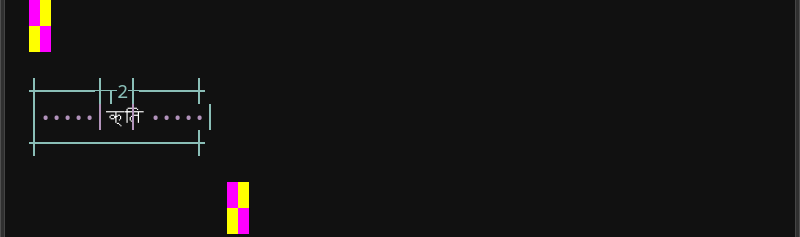
Marathi
Sequence of language Marathi from midpoint of alignment failure records:
# |
Codepoint |
Python |
Category |
wcwidth |
Name |
|---|---|---|---|---|---|
1 |
‘\u0915’ |
Lo |
1 |
DEVANAGARI LETTER KA |
|
2 |
‘\u093e’ |
Mc |
0 |
DEVANAGARI VOWEL SIGN AA |
Total codepoints: 2
Shell test using printf(1),
'|'should align in output:$ printf "\xe0\xa4\x95\xe0\xa4\xbe|\\n12|\\n" का| 12|
Screenshot:
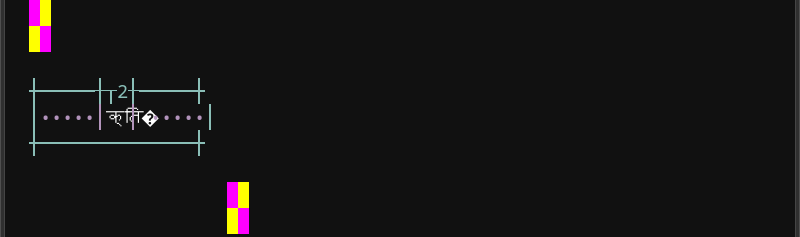
Hindi
Sequence of language Hindi from midpoint of alignment failure records:
# |
Codepoint |
Python |
Category |
wcwidth |
Name |
|---|---|---|---|---|---|
1 |
‘\u0915’ |
Lo |
1 |
DEVANAGARI LETTER KA |
|
2 |
‘\u093e’ |
Mc |
0 |
DEVANAGARI VOWEL SIGN AA |
Total codepoints: 2
Shell test using printf(1),
'|'should align in output:$ printf "\xe0\xa4\x95\xe0\xa4\xbe|\\n12|\\n" का| 12|
Screenshot:
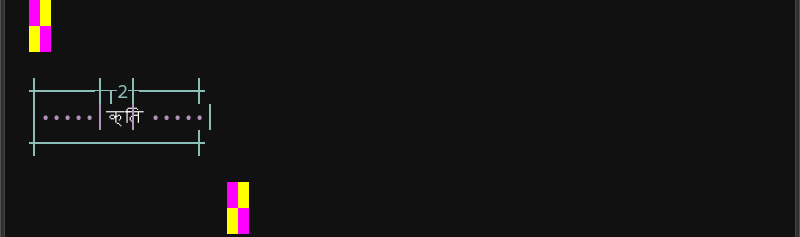
Nepali
Sequence of language Nepali from midpoint of alignment failure records:
# |
Codepoint |
Python |
Category |
wcwidth |
Name |
|---|---|---|---|---|---|
1 |
‘\u0915’ |
Lo |
1 |
DEVANAGARI LETTER KA |
|
2 |
‘\u093e’ |
Mc |
0 |
DEVANAGARI VOWEL SIGN AA |
Total codepoints: 2
Shell test using printf(1),
'|'should align in output:$ printf "\xe0\xa4\x95\xe0\xa4\xbe|\\n12|\\n" का| 12|
Screenshot:
Burmese
Sequence of language Burmese from midpoint of alignment failure records:
# |
Codepoint |
Python |
Category |
wcwidth |
Name |
|---|---|---|---|---|---|
1 |
‘\u1000’ |
Lo |
1 |
MYANMAR LETTER KA |
|
2 |
‘\u1031’ |
Mc |
0 |
MYANMAR VOWEL SIGN E |
Total codepoints: 2
Shell test using printf(1),
'|'should align in output:$ printf "\xe1\x80\x80\xe1\x80\xb1|\\n12|\\n" ကေ| 12|
Screenshot:
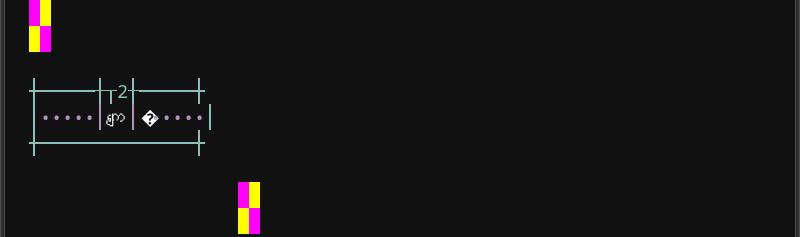
python wcwidth.wcswidth() measures width 2, while mlterm measures width 1.
Maithili
Sequence of language Maithili from midpoint of alignment failure records:
# |
Codepoint |
Python |
Category |
wcwidth |
Name |
|---|---|---|---|---|---|
1 |
‘\u0915’ |
Lo |
1 |
DEVANAGARI LETTER KA |
|
2 |
‘\u093e’ |
Mc |
0 |
DEVANAGARI VOWEL SIGN AA |
Total codepoints: 2
Shell test using printf(1),
'|'should align in output:$ printf "\xe0\xa4\x95\xe0\xa4\xbe|\\n12|\\n" का| 12|
Screenshot:
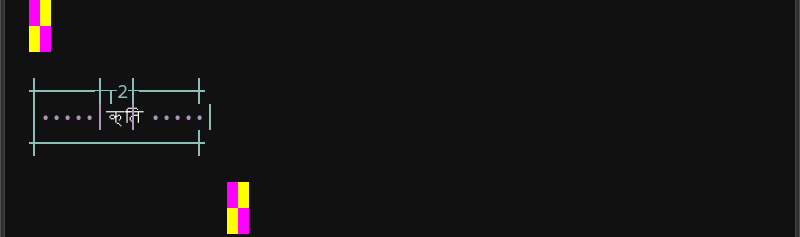
Sanskrit
Sequence of language Sanskrit from midpoint of alignment failure records:
# |
Codepoint |
Python |
Category |
wcwidth |
Name |
|---|---|---|---|---|---|
1 |
‘\u0915’ |
Lo |
1 |
DEVANAGARI LETTER KA |
|
2 |
‘\u093e’ |
Mc |
0 |
DEVANAGARI VOWEL SIGN AA |
Total codepoints: 2
Shell test using printf(1),
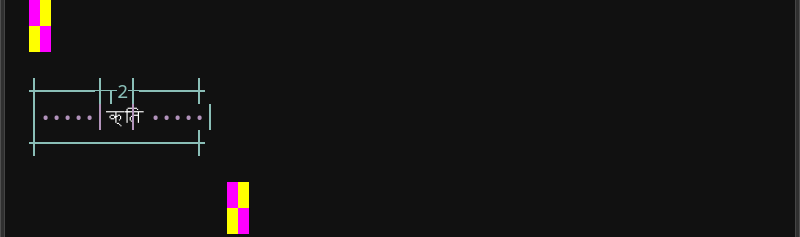
'|'should align in output:$ printf "\xe0\xa4\x95\xe0\xa4\xbe|\\n12|\\n" का| 12|
Screenshot:
Khmer, Central
Sequence of language Khmer, Central from midpoint of alignment failure records:
# |
Codepoint |
Python |
Category |
wcwidth |
Name |
|---|---|---|---|---|---|
1 |
‘\u1780’ |
Lo |
1 |
KHMER LETTER KA |
|
2 |
‘\u17b6’ |
Mc |
0 |
KHMER VOWEL SIGN AA |
Total codepoints: 2
Shell test using printf(1),
'|'should align in output:$ printf "\xe1\x9e\x80\xe1\x9e\xb6|\\n12|\\n" កា| 12|
Screenshot:
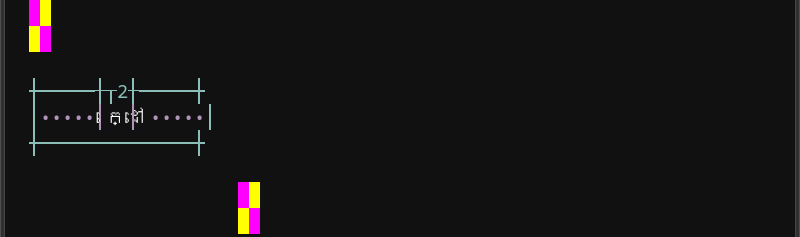
python wcwidth.wcswidth() measures width 2, while mlterm measures width 1.
Telugu
Sequence of language Telugu from midpoint of alignment failure records:
# |
Codepoint |
Python |
Category |
wcwidth |
Name |
|---|---|---|---|---|---|
1 |
‘\u0c05’ |
Lo |
1 |
TELUGU LETTER A |
|
2 |
‘\u0c02’ |
Mc |
0 |
TELUGU SIGN ANUSVARA |
Total codepoints: 2
Shell test using printf(1),
'|'should align in output:$ printf "\xe0\xb0\x85\xe0\xb0\x82|\\n12|\\n" అం| 12|
Screenshot:
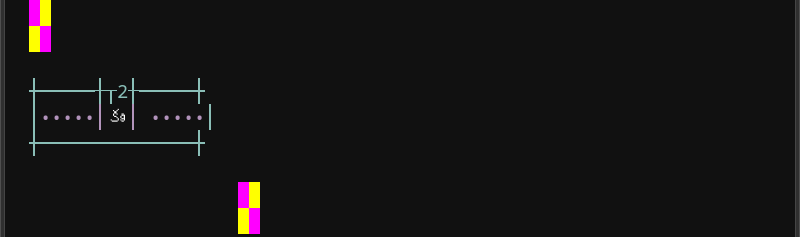
python wcwidth.wcswidth() measures width 2, while mlterm measures width 1.
Mon
Sequence of language Mon from midpoint of alignment failure records:
# |
Codepoint |
Python |
Category |
wcwidth |
Name |
|---|---|---|---|---|---|
1 |
‘\u1000’ |
Lo |
1 |
MYANMAR LETTER KA |
|
2 |
‘\u1031’ |
Mc |
0 |
MYANMAR VOWEL SIGN E |
Total codepoints: 2
Shell test using printf(1),
'|'should align in output:$ printf "\xe1\x80\x80\xe1\x80\xb1|\\n12|\\n" ကေ| 12|
Screenshot:
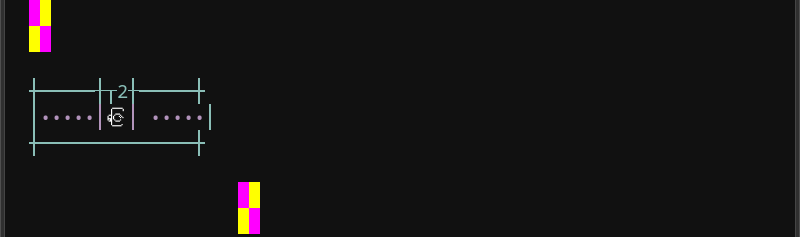
Javanese (Javanese)
Sequence of language Javanese (Javanese) from midpoint of alignment failure records:
# |
Codepoint |
Python |
Category |
wcwidth |
Name |
|---|---|---|---|---|---|
1 |
‘\ua98f’ |
Lo |
1 |
JAVANESE LETTER KA |
|
2 |
‘\ua983’ |
Mc |
0 |
JAVANESE SIGN WIGNYAN |
Total codepoints: 2
Shell test using printf(1),
'|'should align in output:$ printf "\xea\xa6\x8f\xea\xa6\x83|\\n12|\\n" ꦏꦃ| 12|
Screenshot:
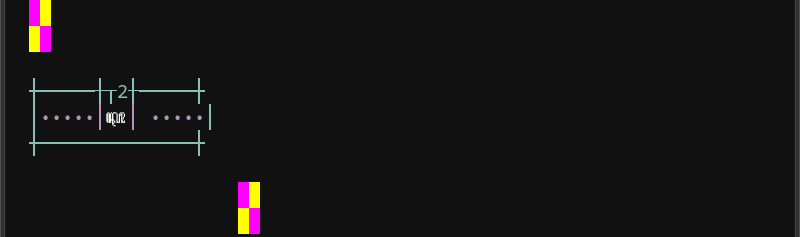
python wcwidth.wcswidth() measures width 2, while mlterm measures width 1.
Khün
Sequence of language Khün from midpoint of alignment failure records:
# |
Codepoint |
Python |
Category |
wcwidth |
Name |
|---|---|---|---|---|---|
1 |
‘\u1a20’ |
Lo |
1 |
TAI THAM LETTER HIGH KA |
|
2 |
‘\u1a6e’ |
Mc |
0 |
TAI THAM VOWEL SIGN E |
|
3 |
‘\u1a62’ |
Mn |
0 |
TAI THAM VOWEL SIGN MAI SAT |
|
4 |
‘\u1a75’ |
Mn |
0 |
TAI THAM SIGN TONE-1 |
Total codepoints: 4
Shell test using printf(1),
'|'should align in output:$ printf "\xe1\xa8\xa0\xe1\xa9\xae\xe1\xa9\xa2\xe1\xa9\xb5|\\n12|\\n" ᨠᩮᩢ᩵| 12|
Screenshot:

python wcwidth.wcswidth() measures width 2, while mlterm measures width 1.
Chakma
Sequence of language Chakma from midpoint of alignment failure records:
# |
Codepoint |
Python |
Category |
wcwidth |
Name |
|---|---|---|---|---|---|
1 |
‘\U00011103’ |
Lo |
1 |
CHAKMA LETTER AA |
|
2 |
‘\U0001112c’ |
Mc |
0 |
CHAKMA VOWEL SIGN E |
Total codepoints: 2
Shell test using printf(1),
'|'should align in output:$ printf "\xf0\x91\x84\x83\xf0\x91\x84\xac|\\n12|\\n" 𑄃𑄬| 12|
Screenshot:
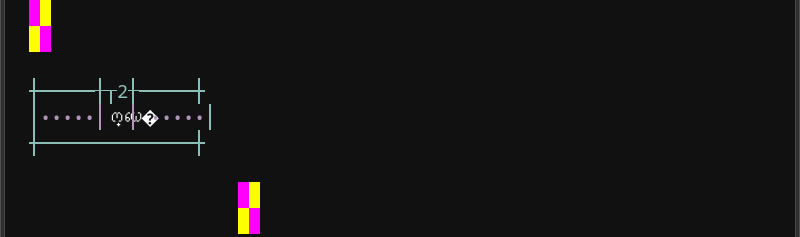
python wcwidth.wcswidth() measures width 2, while mlterm measures width 1.
Shan
Sequence of language Shan from midpoint of alignment failure records:
# |
Codepoint |
Python |
Category |
wcwidth |
Name |
|---|---|---|---|---|---|
1 |
‘\u1010’ |
Lo |
1 |
MYANMAR LETTER TA |
|
2 |
‘\u1031’ |
Mc |
0 |
MYANMAR VOWEL SIGN E |
Total codepoints: 2
Shell test using printf(1),
'|'should align in output:$ printf "\xe1\x80\x90\xe1\x80\xb1|\\n12|\\n" တေ| 12|
Screenshot:
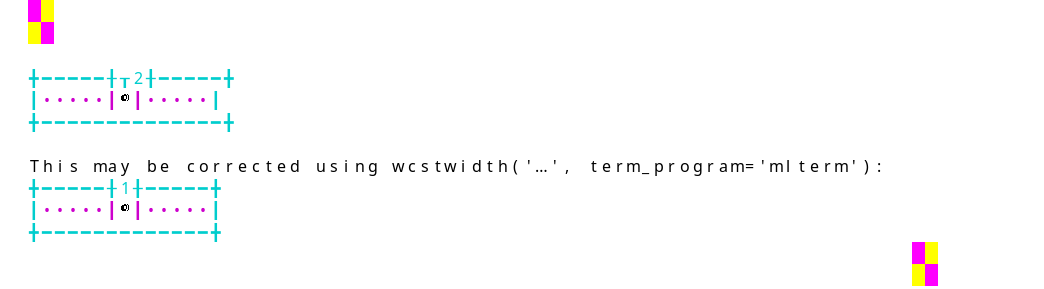
Farsi, Western
Sequence of language Farsi, Western from midpoint of alignment failure records:
# |
Codepoint |
Python |
Category |
wcwidth |
Name |
|---|---|---|---|---|---|
1 |
‘\u062a’ |
Lo |
1 |
ARABIC LETTER TEH |
|
2 |
‘\u200c’ |
Cf |
0 |
ZERO WIDTH NON-JOINER |
Total codepoints: 2
Shell test using printf(1),
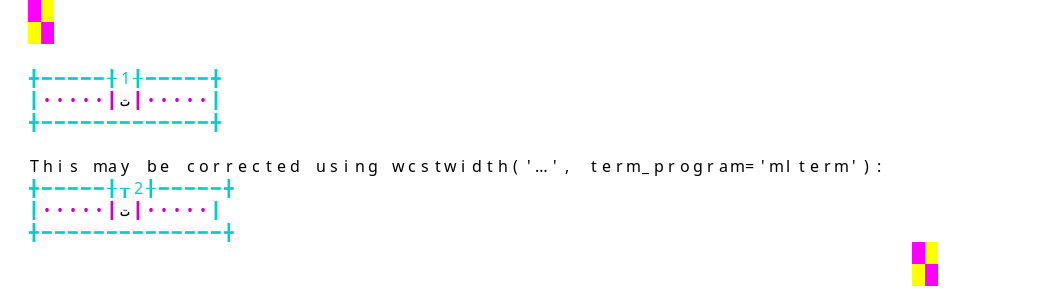
'|'should align in output:$ printf "\xd8\xaa\xe2\x80\x8c|\\n1|\\n" ت| 1|
Screenshot:
Dari
Sequence of language Dari from midpoint of alignment failure records:
# |
Codepoint |
Python |
Category |
wcwidth |
Name |
|---|---|---|---|---|---|
1 |
‘\u062a’ |
Lo |
1 |
ARABIC LETTER TEH |
|
2 |
‘\u200c’ |
Cf |
0 |
ZERO WIDTH NON-JOINER |
Total codepoints: 2
Shell test using printf(1),
'|'should align in output:$ printf "\xd8\xaa\xe2\x80\x8c|\\n1|\\n" ت| 1|
Screenshot:
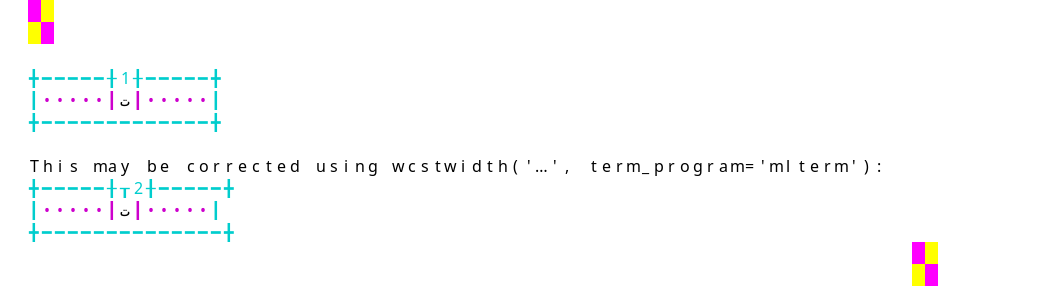
python wcwidth.wcswidth() measures width 1, while mlterm measures width 2.
Panjabi, Western
Sequence of language Panjabi, Western from midpoint of alignment failure records:
# |
Codepoint |
Python |
Category |
wcwidth |
Name |
|---|---|---|---|---|---|
1 |
‘\u06d2’ |
Lo |
1 |
ARABIC LETTER YEH BARREE |
|
2 |
‘\u200c’ |
Cf |
0 |
ZERO WIDTH NON-JOINER |
Total codepoints: 2
Shell test using printf(1),
'|'should align in output:$ printf "\xdb\x92\xe2\x80\x8c|\\n1|\\n" ے| 1|
Screenshot:
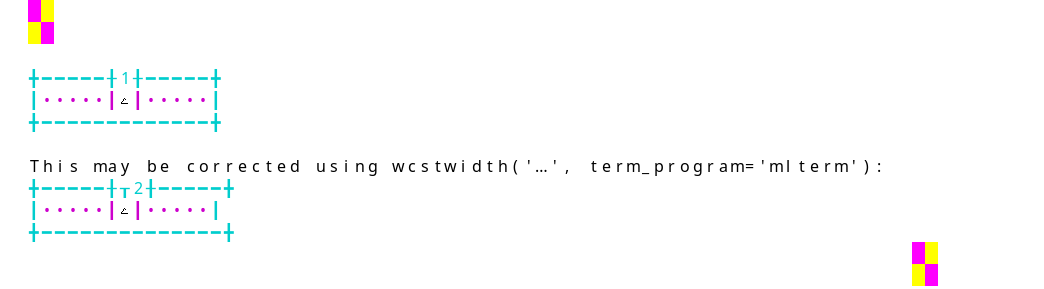
python wcwidth.wcswidth() measures width 1, while mlterm measures width 2.
DEC Private Modes Support
DEC private modes results for mlterm: 3 changeable modes of 3 supported out of 8 total modes tested (37.5% support, 37.5% changeable).
Complete list of DEC private modes tested:
Mode |
Name |
Description |
Supported |
Changeable |
Enabled |
|---|---|---|---|---|---|
1004 |
FOCUS_IN_OUT_EVENTS |
Send FocusIn/FocusOut events |
Yes |
Yes |
No |
1006 |
MOUSE_EXTENDED_SGR |
Enable SGR Mouse Mode |
Yes |
Yes |
No |
2004 |
BRACKETED_PASTE |
Set bracketed paste mode |
Yes |
Yes |
No |
2026 |
SYNCHRONIZED_OUTPUT |
Synchronized Output |
No |
No |
No |
2027 |
GRAPHEME_CLUSTERING |
Grapheme Clustering |
No |
No |
No |
2031 |
COLOR_PALETTE_UPDATES |
Color palette updates |
No |
No |
No |
2048 |
IN_BAND_WINDOW_RESIZE |
In-Band Window Resize Notifications |
No |
No |
No |
5522 |
BRACKETED_PASTE_MIME |
Bracketed Paste MIME |
No |
No |
No |
Summary: 3 changeable, 5 not changeable.
Kitty Keyboard Protocol
mlterm does not support the Kitty keyboard protocol.
XTGETTCAP (Terminfo Capabilities)
mlterm supports the XTGETTCAP sequence and reports 38 terminfo capabilities (Partial).
# |
Capability |
Description |
Value |
|---|---|---|---|
1 |
TN |
Terminal name |
|
2 |
colors |
Max colors on screen |
|
3 |
kEND |
Shifted end key |
|
4 |
kHOM |
Shifted home key |
|
5 |
kLFT |
Shifted left-arrow key |
|
6 |
kNXT |
Shifted next-page key |
|
7 |
kPRV |
Shifted previous-page key |
|
8 |
kRIT |
Shifted right-arrow key |
|
9 |
ka1 |
Keypad upper left |
|
10 |
ka3 |
Keypad upper right |
|
11 |
kbs |
Backspace key |
|
12 |
kc1 |
Keypad lower left |
|
13 |
kc3 |
Keypad lower right |
|
14 |
kcbt |
Back-tab key |
|
15 |
kcub1 |
Left arrow key |
|
16 |
kcud1 |
Down arrow key |
|
17 |
kcuf1 |
Right arrow key |
|
18 |
kcuu1 |
Up arrow key |
|
19 |
kdch1 |
Delete character key |
|
20 |
kend |
End key |
|
21 |
kf1 |
Function key F1 |
|
22 |
kf10 |
Function key F10 |
|
23 |
kf11 |
Function key F11 |
|
24 |
kf12 |
Function key F12 |
|
25 |
kf2 |
Function key F2 |
|
26 |
kf3 |
Function key F3 |
|
27 |
kf4 |
Function key F4 |
|
28 |
kf5 |
Function key F5 |
|
29 |
kf6 |
Function key F6 |
|
30 |
kf7 |
Function key F7 |
|
31 |
kf8 |
Function key F8 |
|
32 |
kf9 |
Function key F9 |
|
33 |
khome |
Home key |
|
34 |
kich1 |
Insert character key |
|
35 |
kind |
Scroll-down key |
|
36 |
knp |
Next page key |
|
37 |
kpp |
Previous page key |
|
38 |
kri |
Scroll-up key |
|
The XTGETTCAP sequence (DCS + q Pt ST) allows applications to query
terminfo capabilities directly from the terminal emulator, rather than relying
on the system terminfo database.
Text Sizing Protocol (OSC 66)
mlterm does not support the Text Sizing protocol.
Tofu Detection
A tofu is the □ U+25A1 WHITE SQUARE placeholder box drawn in place of
a codepoint the terminal’s font has no glyph for. Two protocols allow a
program to ask which codepoints may ‘tofu’: mintty’s Font
Glyph Coverage Enquiry and the Glyph Protocol implemented first by Rio.
mlterm does not answer a font glyph coverage enquiry by either protocol, ‘tofus’ cannot be determined by automatic code.
Truecolor Support
mlterm supports 24-bit truecolor, detectable via:
XTGETTCAP (RGB capability): no
DECRQSS (truecolor probe): no
COLORTERM: yes (truecolor)
Warning
COLORTERM is an environment variable, not a terminal query. It is not forwarded over SSH without SendEnv / AcceptEnv configuration, so detection via COLORTERM alone may be unreliable on remote hosts.
OSC 52 Clipboard Support
mlterm does not advertise OSC 52 clipboard support via DA1 extension 52 or XTGETTCAP Ms.
DA1 extension 52: no
XTGETTCAP Ms: no
Terminal Identification
mlterm is identified as mlterm version 3.9.4 (detected via XTVERSION + XTGETTCAP TN).
XTVERSION (raw): mlterm(3.9.4)
XTVERSION: yes
XTGETTCAP TN: yes (mlterm)
ENQ: no
TERM_PROGRAM: no
TERM: no (xterm)
Reproduction
To reproduce these results for mlterm, install and run ucs-detect with the following commands:
uvx ucs-detect --rerun data/mlterm.yaml
Test Performance
The test suite completed in 31.34 seconds (31s).
Mean CPU: 52.1%
Mean RSS: 28.1 MB
Total time: 31.3s
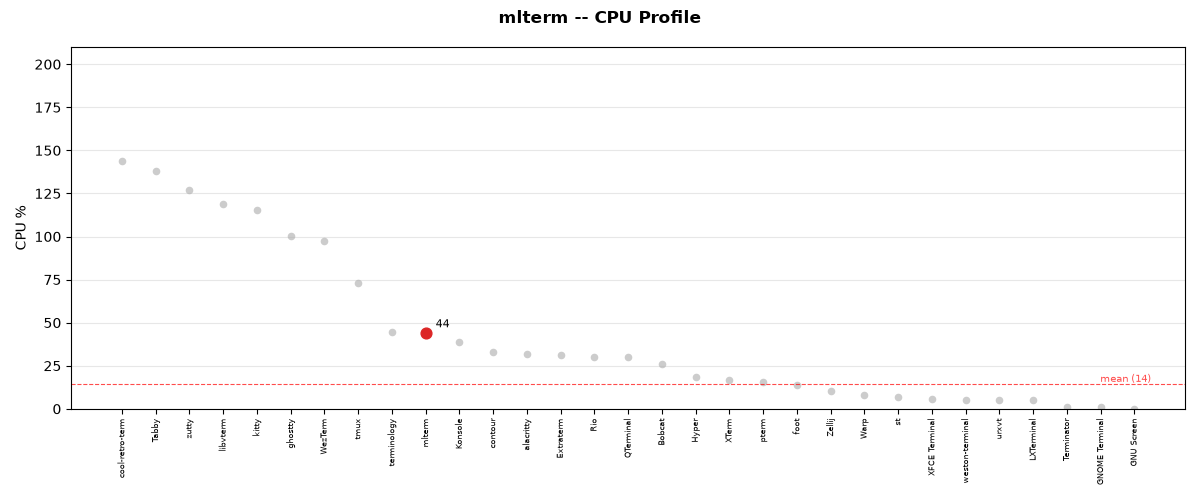
CPU usage during test execution for mlterm.
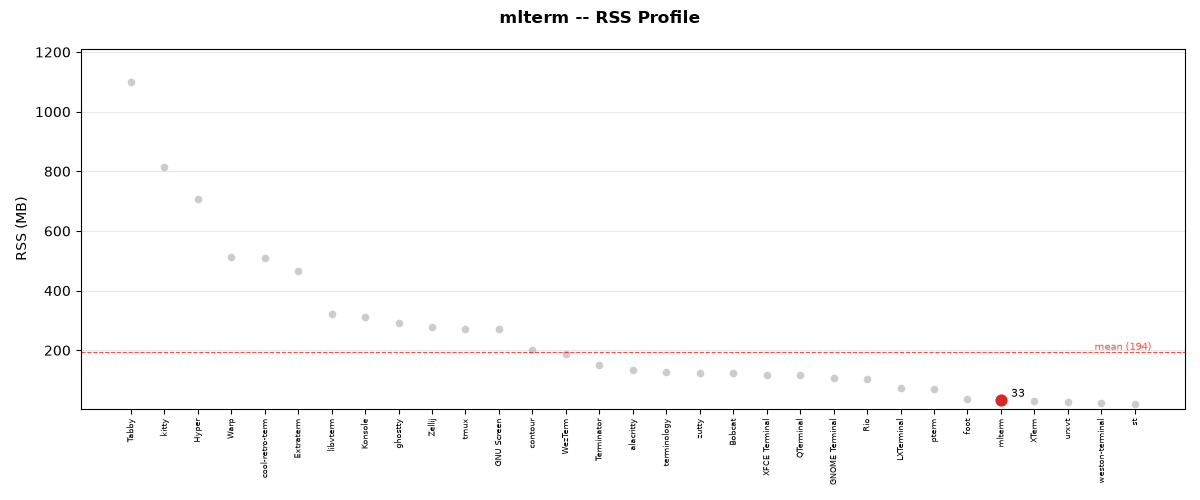
RSS memory usage during test execution for mlterm.
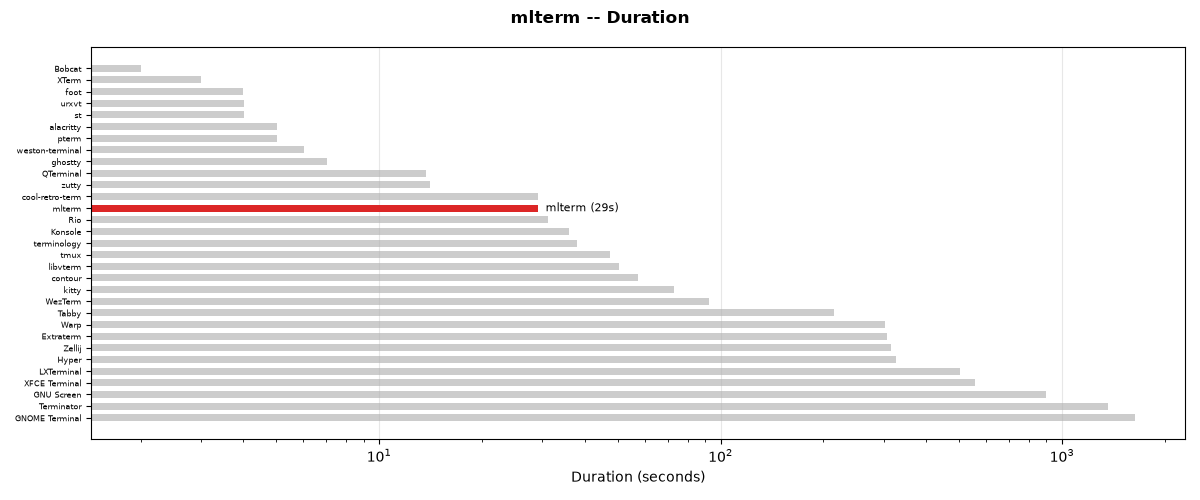
Test duration for mlterm compared to all other terminals.
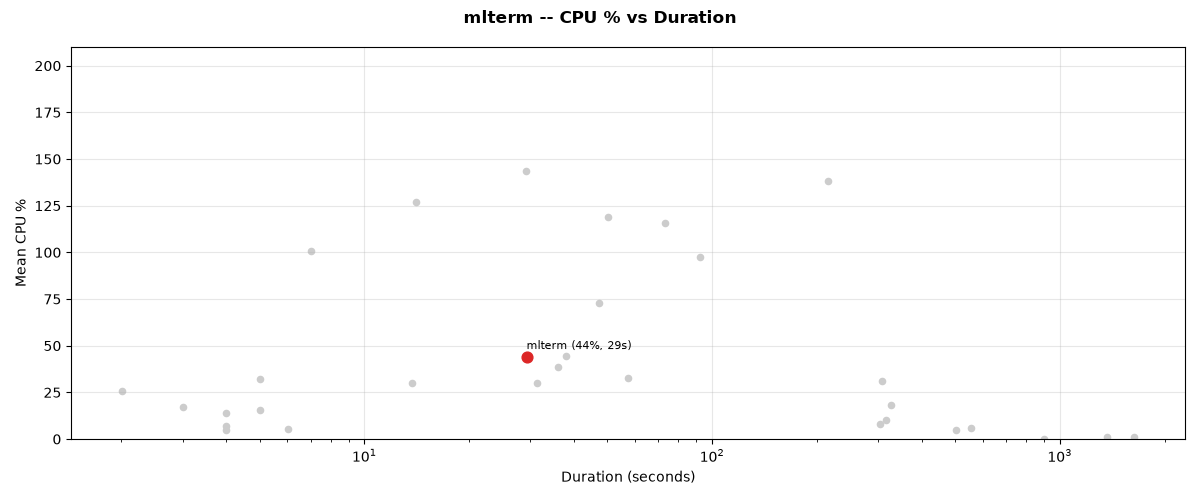
CPU % vs duration trade-off for mlterm.